Jesus as the Key to Scripture
This is part 2 of a sermon I gave at my church at the end of September about reading Scripture. Part 1 is here. I gave this talk on the Sunday before the National Day for Truth and Reconciliation, so some of the text is referring to that.

Although today our focus is not going to be on the themes of Truth and Reconciliation Day, we are going to be talking about what it means to listen and interpret in a manner that reflects the divine humility we discussed last week. Our focus is going to be on scripture, but I hope you will find space in this next week to spend some time reflecting on how to listen well to our Indigenous neighbours and look for ways to act in light of that listening. That posture of listening and response is the one we are being invited to take with the Bible as well.
Interpretation is in the eye of the beholder
Ruth and I went out last week with my cousin and his wife to celebrate a big anniversary. 25 years ago, our barely adult selves travelled all the way to London, England to embark on a three-month backpacking trip around Europe. I kept a journal during the trip and, to be honest, I hadn’t read it in years. So I dug it out and started looking through it. I have cringed or blushed so many times reading it. It has been an experience.
Here’s an entry that seems relevant to what we are wanting to talk about today and may make you feel embarrassed for my 18-year-old self as well. This is the entry for September 23, 2000:
We continued […] up to Liverpool. Jason and I, while we were there, saw the Yellow Submarine, and the Tate Gallery. The art there was CRAP! If that’s art, then call me Leonardo…
In case you are curious to know what kinds of art me and Jason saw at the Tate gallery in Liverpool, here’s a quick taste.

Interpreting is something that we are doing constantly – even young cultural philistines like myself. We take in the world around us. We let our perceptions zero in on this or that. And then we decide on the significance of what we have perceived using a variety of criteria.
I’m an English major, so – besides having an informed opinion on whether you should use an Oxford comma or not – interpretation is really our only skill. Or, if not a skill, it’s still something that I have thought an awful lot about over the years. Just what does it mean to interpret something? How do we do it? How can we understand anything at all? And, if we are able to understand it, just what should we do with that?
All of this, of course, is essential to the question we left off with last week. We were exploring the manner in which God speaks to us through the Bible. We found that one of God’s primary characteristics in speaking to us through language is his humility. This week, we want to start from the assumption that God speaks, and start to look at the task of learning how to listen well.
All of this talk of “interpretation,” though, might feel a bit strange to you, depending on what your church background is. Most Christian traditions recognize that reading the Bible involves this layer of mediation called “interpretation.” But, for some of us, that layer is razor-thin. Translucent, even.
Literal Interpretation
“God said it. I believe it. That settles it.”
Has anyone heard that saying before? I tried to find the origin of it, but most folks seem to just call it a “bumper-sticker saying.” I can’t quite imagine a more bizarre bumper-sticker. You’d have to be assuming that most people drive around thinking about the Bible, I guess? Apparently, the original saying was by a missionary named Smith Wigglesworth. I think that should be on a bumper sticker.

Wigglesworth’s saying describes a way of approaching the Bible that many of us are probably familiar with. Sometimes it’s called, “Biblical literalism,” or a naive approach to Scripture (“naive” not being meant in a mean way – but more in the sense of “unmediated” or “unreflective”). This is the WYSIWIG way of reading the Bible: what you see is what you get. The plain reading of scripture.
I want to talk just a bit about this way of reading the Bible because I think it’s pretty far-reaching. If you’ve ever talked with someone about differing perspectives on the Bible, you can be sure the conversation will have a hard time moving forward if the other person says, “I just read the Bible as it’s written.” Shrug. Conversation over.
It’s worth taking a closer look, though. Not because the Bible should never be read literally, but because “reading literally” is more complicated than we might think. Karen Keen’s book on The Word of a Humble God, which we discussed last week, explores these nuances at length, and I want to take a look at some of her examples of so-called “literal readings” to try to go deeper.1
Calvin’s Literalism
To demonstrate how a “literal” approach can result in different readings, Keen offers up two sample interpretations: one from John Calvin and one from some 3rd-century Jewish rabbis.
For Calvin, she uses his commentary on the book of Joshua. Joshua 7 talks about a man named Achan, who sinned by taking plunder after the fall of Jericho. When he is discovered, we’re told in verse 24 and 25:
Joshua, together with all Israel, took Achan […] his sons and daughters, his cattle, donkeys and sheep, his tent and all that he had, to the Valley of Achor. Joshua said, ‘Why have you brought this trouble on us? The Lord will bring trouble on you today.’ Then all Israel stoned him, and after they had stoned the rest, they burned them.
Here’s what Calvin says about that verse:
If any one is disturbed and offended by the severity of the punishment, he must always be brought back to this point, that though our reason dissent from the judgments of God, we must check our presumption by the curb of a pious modesty and soberness, and not disapprove whatever does not please us.
On the one hand, I admire that Calvin calls attention to the fact that no one really likes this thing that is being recounted. Even in the 1500s, people didn’t like it, apparently. Calvin’s takeaway, however, is not to question it. Instead, his takeaway is: “God said it. I believe it. That settles it.”
Calvin reads this passage literally – but it’s more complicated than that. For example, at one point a little bit later in his commentary, Calvin raises a passage – what we might call an intertext – in Ezekiel 18:20 about how children shouldn’t be punished for the sins of their parents. He’s aware of the pushback someone might have to the acceptance of the event in this chapter. Ezekiel explicitly says that what is happening here is not what God desires.
Yet Calvin, attempting to suspend his judgment, decides that the verse in Ezekiel does not apply here:
… if we consider how much more deeply divine knowledge penetrates than human intellect can possibly do, we will rather acquiesce in his decree, than hurry ourselves to a precipice by giving way to presumption and extravagant pride.
About this interpretation, Keen says: “Here Calvin’s theological understanding of God’s sovereignty and divine knowledge dictates his literal reading.”
Despite the intertext from Ezekiel, which is literally demanding that there be some kind of tension in Calvin’s reading of Joshua 7, Calvin lets his doctrinal expectations lead. God knows best. God is sovereign. Now, these are doctrinal positions that we can derive from other parts of scripture, which are being applied here. But they are positions that Calvin chooses to prioritize over other clear teachings elsewhere. His literal reading has somewhat invisible, external supports.
Rabbinical Literalism
It turns out, though, that most literal readings require these external supports. Again, this isn’t a “gotcha” moment in the book – it’s actually just a helpful reminder that the “plain reading of scripture” often comes with hidden scaffolding and, because of that, it can generate many different interpretations. As a point of contrast, Keen explores a reading from a 3rd century Jewish rabbinical commentary called Sifre Deuteronomy. I won’t go into all of the details because of time, but it is fascinating.
The passage that the rabbis are reading is a commandment in Deuteronomy 13:12-15:
If you hear it said about one of the towns […] that scoundrels from among you have gone out and led the inhabitants of their town astray,” then “you must certainly put to the sword all who live in that town. You must destroy it completely, both its people and its livestock.
The rabbinical reading takes these words extremely literally. In fact, their interpretative approach (their hermeneutics) makes me think of that thing little kids sometimes do. Mom says, “Pick up all your toys,” to their kid. When she comes back five minutes later, the toys are all still there. The kid shrugs and says, “I did. I picked each of them up and then put them back down.”
And then the child is sent to live on the moon.
These rabbis encounter the difficulty of this text, which again is encouraging violence, including against children, and they decide to uncover within the words of the text itself a means of limiting that violence. So, for example, the phrase “If you hear,” was taken to mean that it is not necessary to go looking for apostate towns. The word “scoundrels” in Hebrew is masculine and plural, which means that the command only applies if it is men who corrupt the town – and at least two men. The rabbis also choose – in contrast to Calvin – to rely upon an intertext that says that children should not be put to death for their parents’ sins and so they assume that God cannot have meant for children to be included in this command.
For the rabbis, the literal is guided by the grammatical – what did God say exactly, both here and elsewhere in scripture?
Waves of Inspiration
Neither of these readings may provide a satisfactory solution to the very real challenge of those texts. At the same time, though, the point of the comparison is actually just to say that every reading is going to generate somewhat diverse meanings – even when you are trying to just “stick to the text.”
The idea of “diverse meanings” can be a bit scary. We prefer for there to just be one meaning. Yet this has never been the case. The last part of Keen’s book explores the history of Biblical interpretation from the time of the early church and into the medieval era, the way this shifts during the Enlightenment, and some of the ways that it has further shifted today. People of God, throughout human history, have been struggling to understand this book: what God was saying to the people who first received it and what God is saying now.
Keen’s takeaway from all of this is that:
When we focus on the mistakes of past interpreters more than their gifts, we fail to appreciate that God has been, currently is, and always will be active to effect Divine purposes. God is at work in each generation and every generation has something to offer.
This is a great way to approach interpretations that you disagree with. I really don’t agree with Calvin’s takeaways, but, man, he is so good at close reading. He doesn’t just skip over stuff – which is something you see in so many commentaries. He calls out the parts that are frustrating in a super admirable way. And these rabbis help us to keep really close to the text. They can help us to stick close to what’s being said and not just assume that our summary is identical with the text. (Because you know what assuming does…)
Looking for the Moon
As someone who is more-or-less dyed-in-the-wool “postmodern,” I will admit that the idea of multiple, diverse interpretations doesn’t stress me out at all. We postmoderns love indeterminacy. We live in the in-between. We float in a sea of potentiality. Many of us are very obnoxious, actually.
Yet, in contrast to some of my fellow postmoderns, I don’t believe that this diversity stems from a meaninglessness at the core of all things; instead, I believe this variety is inevitable because:
- the God revealed in scripture is infinite,
- we creatures to whom God has entrusted his word are finite and yet also reflective of a wide diversity of cultures and contexts, and
- language can only do so much.
So, it is possible to be open to multiple interpretations of scripture and still believe that these interpretations can be nearer or further away from the truth. It is possible to believe that truth can be obtained through the reading of this ancient book. It is possible to believe that God still speaks and to believe that we can hear God. In fact, it’s possible to believe that God’s word is a lamp unto our feet and a light unto our path.
My sister recently brought home a very powerful telescope. She set it up outside on her driveway at night, and we all took turns looking through the eyepiece. But you know how hard it can be to centre your eye in those things? More often than not you end up just seeing your own eyelashes. It can get so frustrating that you might just sigh and decide to go back inside. I can see the sky well enough without it.
But if you keep working at it, trying to understand this tool that we’ve got in front of us, with its symbols and dials, you might be able to hold still enough to actually see. And then all of a sudden the field of vision is full of a real, live moon so large that you can even see the craters.

That’s what interpretation is like too. This book is hard. There are things that are hard to understand (even though the theo-bros act like the real problem is that we’re snowflakes)! But if we can find a way to hold still enough to actually see – the promise of that real, live moon is what drives us.
The Cross-Shaped Bounds of Interpretation
Last time, I quoted a line in Keen’s book that “What sets the biblical narrative apart is not that it has exclusive knowledge of ancient Israel or Judah or Jesus but that its particular angle provides divinely revelatory insight.”
But what is that divinely revelatory insight?
The first followers of Jesus were looking for it. You hear it in their response to his teaching: “He taught as one who had authority.” You see it in the trust they put in him, “Just say the word, and my servant will be healed.”
There’s a rumour going around about this guy.
I want us to imagine for a moment what it might have been like to be one of Jesus’s disciples in the hours after his death. The confusion you must have felt. The bewilderment – you had some vague sense that “he was the one who was going to redeem Israel,” but you must have been wrong. And then you and a friend are on your way home, demoralized.
You’re walking along when a third person joins you. You don’t recognize him. You get to talking and the guy says, “Why the long face?” You and your friend just look at each other. How has this guy not heard about Jesus, you wonder? Has he been living under a rock? (Spoiler: he has.)
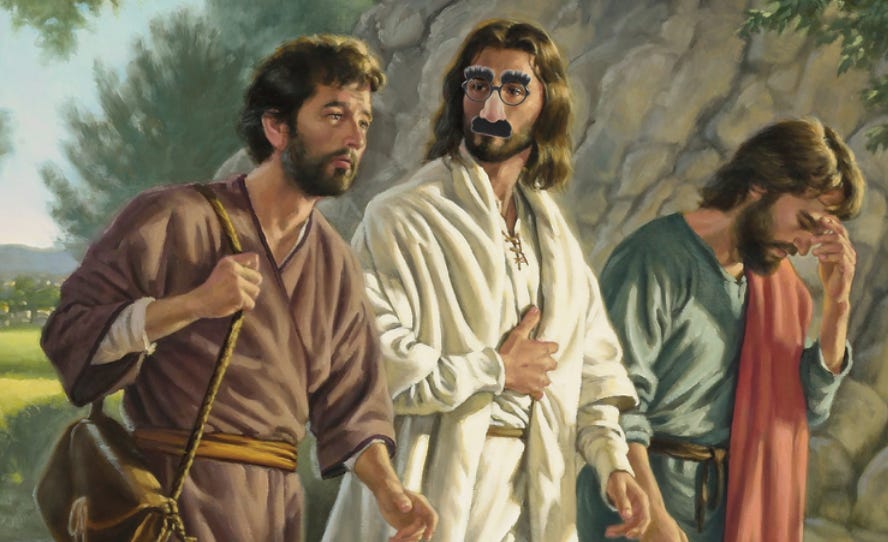
I imagine the guy at this point cracking his knuckles and doing a big stretch, because he’s about to get into it.
Because, you don’t realize it, but this is in fact Jesus, your rabbi, raised from death to life, and about to give you a lesson you’ll never forget. This is what it says in Luke 24:
He said to them, ‘How foolish you are, and how slow to believe all that the prophets have spoken! Did not the Messiah have to suffer these things and then enter his glory?’ And beginning with Moses and all the Prophets, he explained to them what was said in all the Scriptures concerning himself.
This book is talking about Jesus all the way through. In fact, the purpose of the words of this book is to lead us to the Word. Because the Word of God is a person. As we encounter him and learn to do life with him, his word to us helps us understand these words.
So, in the end, the diversity of interpretation is not limitless. There is a truth against which all interpretations will ultimately stumble. Yet that truth is not a proposition; it’s Jesus.
The Community of Jesus
It’s one thing to say, “I’m going to read the Bible through the lens of this or that topic – wealth, violence, gender, etc.” That kind of reading is always inevitably going to be doing some picking and choosing because those topics aren’t relevant all the way through the text.
It’s quite another thing to say, “I’m going to read the Bible through the lens of Jesus. I’m going to let Jesus ground my reading of this book.” This isn’t topical anymore. It’s personal.
But maybe it’s not that different than actually reading the Bible with another person. You might have had that experience. (You’re going to shortly, actually!) Someone reads the passage. You go around the circle asking what jumped out at people.
What jumped out at you, Jesus?
You spend some time in your circle talking about what you found hard about the passage and why.
What did you find hard about this passage, Jesus?
Is it possible to read the Bible in that way? It means that we would need to suspend judgment of a passage until we discovered the traces of Jesus in it. It means that we also may not get all the answers – Jesus often didn’t give us all the answers, or he left us with more questions. It also probably means that we do need to read the Bible with others and in community more often. After all, the way I perceive Jesus and the way you perceive him aren’t going to be the same. We need each other to get a 360 degree view.
Ultimately, reading the Bible this way requires a similar humility to what God has shown in allowing us to know him through language and this book. It requires the kind of humility that we are called to show other people too. It’s the kind of humility that is required to pursue Truth and Reconciliation. To sit in a room together, holding different perspectives, but oriented in a similar direction: towards healing. All of this is connected, after all.
Keen offers this helpful test:
How can you determine if you know God and thus can recognize Jesus in scripture? How can Christ become the hermeneutical lens for every biblical passage you read? Your life is characterized by love. But this is not ‘love’ however we want to define it. This is a love that is an outpouring of humility. (172).
Weirdly, the key to hearing God speak through this book is to allow God first to change your heart to be like his. The more he does that, the more you will be able to discern the ways his word can light your path.
Where to next?
I am hoping that these last two Sundays do more than just help us to nod more kindly at the dusty, leather-bound volume buried on a bookshelf.
- I want to encourage all of us to try to dig into the Bible. Go slow. Focus on the easy stuff at least to start. Don’t read stuff just to make yourself mad, but also let yourself be stretched. Go back to the Gospels to help set the tone.
- For me, it’s pretty clear that I need to re-read the prophets again. These were by far the hardest part of the Bible for me to get through in my recent re-read. I’m going to be reading through Jeremiah over the next little while, so if anyone is interested in doing that with me, let me know. That could make it a little less bleak.
This book is hard – but there are so many resources out there. Just last week, Andy sent me a podcast episode that digs more into a bunch of questions about how to read the Bible. I’ll stick in the next church email. There’s also great podcasts like the BibleProject or Exploring My Strange Bible (both affiliated with Tim Mackie). I’ve heard good things about The Bible for Normal People (by Pete Enns). There’s one that’s a bit nerdier called Hebrew Bible Insights that I’ve enjoyed. There are books and books and books. Lori reminded me about Greg Boyd’s book Imperfect Inspiration, which I should have cited more here, but which is really great. One of my favourite books about Biblical origins is Bruce Metzger’s Textual Criticism of the New Testament.
By way of a closing thought, I want to offer up one more quote from Keen’s book. To me it helps me to see that we’re not just looking for a lamp to light my path, but actually the hope of the gospel is that we all would become lights, reflecting the true light of the world, Jesus, and together becoming a path of love that helps to turn the hearts of all creation towards home.
“Scripture is meant to form us to reflect the image of God in Christ to each other and the rest of creation. That’s our common goal as we read the Bible together.”
- In case, it is not sufficiently clear here, both this talk and my previous talk draw extensively from the excellent work that Karen Keen has done in her book, The Word of a Humble God (Eerdmans, 2022). People from our church did the book as a book study and these talks were intended to provide people an overview and key takeaways. ↩︎