A Story of Land, Power, and Resistance
Family history is full of surprises, yielding new insights even in areas that have been gone over many times. I’ve looked at my Henderson ancestry before. My mother’s family, the Hendersons, came to Canada around the time of the First World War, settling in Toronto. The story of Alexander Henderson, her grandfather, is one that should be told — his singing at Carnegie Hall before the war, his marriage to Maggie Roy, his war injuries, his post-war career as a bookbinder, and untimely death — but that is going to have to wait.
Instead, I have to tell the story of Alexander’s uncle, Colin Henderson, and the events of Alexander’s father’s birthplace, the island of Tiree on the westernmost edge of the Inner Hebrides.
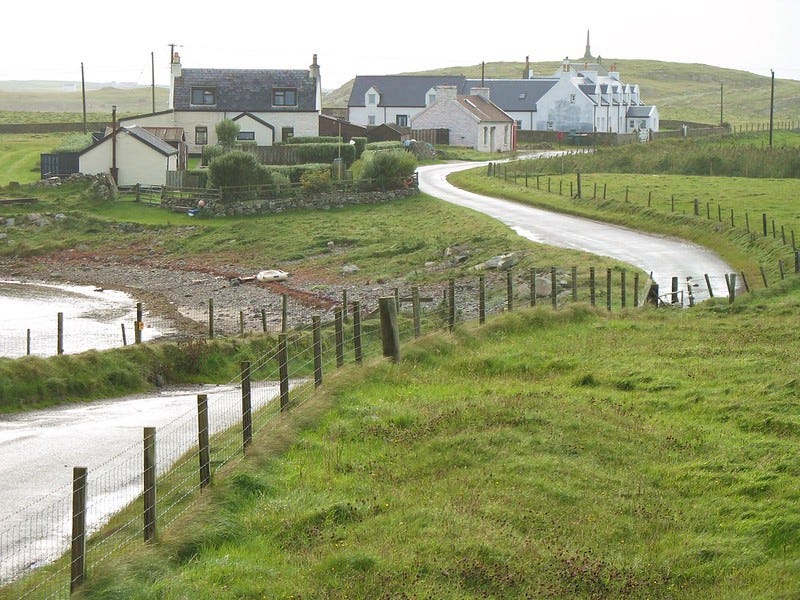
As usual, though, when recounting stories from history, I find that I need to tell an earlier story from history first.
So let’s start by going backwards a few generations. My grandfather Angus Henderson (born in Toronto) was the son of Alexander Henderson (born in Glasgow), who was the son of Donald (born in Tiree), who was the son of another Alexander (born in Tiree), who was the son of Archibald (born in 1780 in the very-fun-to-say peninsula of Ardnamurchan).
At some point in the early 1820s, Archibald took his family over to settle on the island of Tiree. He worked as an agricultural labourer for several decades, residing on a small “croft” (essentially an enclosed piece of land) near the Chamberlaine of the Duke of Argyll, a man named John Campbell, who was also known as Am Bàillidh Mòr or “the Big Factor.” He was the land agent for the Duke of Argyll who owned Tiree.
Archibald’s position changed sometime around 1861, when he was 81 years old. In the census for that year, Archibald Henderson is no longer listed as an agricultural labourer. Instead, he is listed as a “pauper.” (His wife Nancy is listed as “pauper’s wife,” although presumably she was also a pauper.)
The implications of this shift are somewhat massive for the Henderson family, yet the shift itself is also symptomatic of an even more massive historical development that — you guessed it — gets its start several decades earlier.
To understand how Archibald Henderson became a pauper, and especially to understand what happens next, we need to unpack the nature of land access in the Scottish highlands beginning in the late 1700s.
From clan chief to landlord
We associate Scotland with clans — after all, what’s Scotland without a Clan MacGregor?

I still remember when my cousin and I visited Hadrian’s famous wall separating England and Scotland. It’s a low stone barrier that had nearly faded into the landscape 2,000 years after it was built — yet it was a wall nonetheless. We sometimes forget that Scotland’s history is very distinct from that of the English — except when it isn’t and in those cases the English are usually oppressing the Scots.
The ongoing conflict between England and Scotland has always been complex. For many years, England had even been ruled by a Scottish king. The Stuarts, descended from Mary Queen of Scots, had come to the throne with James I (also known as James VI in Scotland). Of course, the English under Cromwell had killed James I’s son Charles I during its brief foray into republicanism. And that had never sat well with the Scots.
The so-called Glorious Revolution of 1689 made things even worse. Fearing that Charles’s Catholic son, James II (whose older brother Charles II had been invited back to rule after the conclusion of the English Civil War), would return the now-solidly Protestant nation to Catholicism, Parliament concocted a scheme that would force James II to abdicate. This made space for Protestant rulers, William of Orange and his wife Mary (a daughter of James II), to ascend the throne — or thrones, I suppose — instead.
Although many in Scotland approved of this shift, there were also many supporters of the Stuarts remaining, especially in the Highlands. This loyalty gave rise to a series of rebellions called “the Jacobite Rebellions” (“Jacobus” is the Latin form of James). This period in British history is fascinating as is the complex contortions Parliament was forced to adopt in order to maintain some semblance of genealogical succession while avoiding Catholic rule.1
There were several failed Jacobite Rebellions, including most notably in 1715 and 1719. Several decades later, in 1745, James III’s son, “Bonnie” Prince Charlie, decided to capitalize on the Highlanders’ ongoing loyalty and invaded England again. (This loyalty was intensified partly by their hatred of the monarchy’s major supporter, the Duke of Argyll, about whom more below).
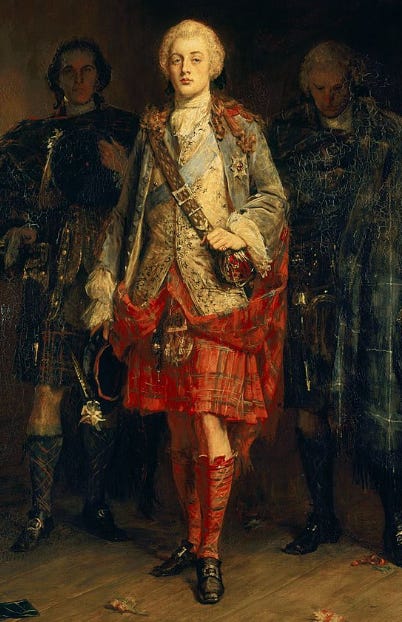
The ’45, as the 1745 rebellion came to be called, failed spectacularly. This time, perceiving the ongoing threat Scottish pride represented, England issued the devastating Act of Proscription. This outlawed many key aspects of Scottish culture — the playing of pipes, the wearing of tartans, and even the speaking of Gaelic — and it further perpetuated the breakdown of the clans, which had for centuries been a core organizing principle for Scottish peoples.
(We’re getting a bit far afield here, I realize, but I promise it relates to the story of my ancestor, Colin Henderson, and his grandfather, Archibald.)
Historically, agriculture in the Highlands of Scotland (and, actually, in many places throughout the British Isles) was conducted communally. Land tended to be shared and much of it was treated as “commons” belonging to the monarch and available for public use without reference to a particular landlord. These landlords were aristocrats who, in many cases in Scotland at least, had at one time been clan chiefs, responsible for the care of those loyal to them. Over the course of the 18th century, these ties of fidelity became less and less important in the face of growing debts incurred by the landlords to pay for their luxurious lifestyles. Rather than kin, the families who farmed and lived on their ever-expanding lands had become tenants.
(Of course, it is all much more complicated than I’ve summarized above, but hopefully the shift is somewhat clear. Many of the sources I consulted were also quick to emphasize that the clan/commons system that preceded the land/tenant system had many of its own unique flaws.)
When one begins thinking of oneself as a “landlord” with “property” and (especially) mounting expenses, one might begin to look for ways to increase one’s revenues. Hence the emergence of “improvement” as a key goal for landowners. Land treated as commons did not get maximized for use, so it gradually got enclosed within existing properties, meaning that it was no longer accessible except by approved and paying tenants. This made things increasingly difficult for the average person to make ends meet and increasingly important that they get access to land themselves through tenancy.
The landlords capitalized on this need, though, by having prospective tenants bid on rental opportunities.2 They might cut a deal for a family member, but if you weren’t related, or — even worse — if you happened to be part of a family that were enemies to the ruling power, you might find yourself in a dire strait not unlike that of my great-great-great-great-grandfather Archie (or, as he probably would have been known, since most of the folks on Tiree spoke Gaelic, Eairdsidh).3
The Old Man and the Fishing Boat
Ok, so I think we’ve more or less arrived back in 1861. It’s over a century after the Act of Proscription and, although that Act was repealed in 1782, and, although Walter Scott had reinvigorated a lot of Scottish culture through his historical novels, the ramifications of all of these events continue to be felt in the power dynamics on the island of Tiree.
The Duke of Argyll is also the chief of the Clan Campbell, which was the major supporter of the monarchy against the Stuarts during the rebellions. His Chamberlain, John Campbell, was in charge of Tiree for much of Archibald’s residence on the island. The man had a widespread reputation for being cruel. He was responsible for many evictions (carrying out the somewhat monstrous instructions of his master, the 8th Duke of Argyll) and for pressuring poor tenants to emigrate to Canada.4 In fact, he was so notorious that, when he died in 1872, some of his former tenants wrote a song to celebrate.
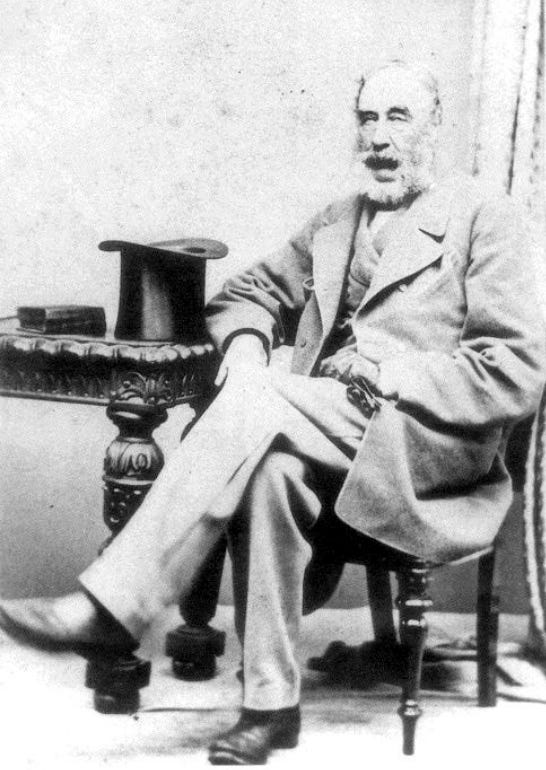
We do not know the exact year in which Archibald Henderson became a pauper, but we do know more or less what happened, partly due to this remarkable recording that was made in 1974.5
(I’ll preface my account by saying that the interviewee in the recording says that it was Archibald’s son Alexander who was evicted. Based on the census records, I think that he is misremembering. This feels like a bit of a claim on my part since the interviewee actually knew Colin Henderson, Alexander’s son, but I think it makes more sense in the timeline if it was Archibald. In any case, the census does say that Archibald was a pauper for a period in the 1860s, which means he was evicted from the land.)
To summarize, Archibald Henderson and his wife, despite working as agricultural labourers for decades on Tiree, were kicked off their croft by the Big Factor, John Campbell, and forced to live for a time under a fishing boat. A fishing boat! The man was 81 years old at the time! What kind of person would do such a thing and think it’s ok?6
The interviewee goes on to tell us how, one day, some cattle belonging to the Big Factor were being brought to shore. Archibald saw that the men were needing help and so came over to pitch in. The Big Factor saw him do this. Later, he called him over from under his fishing boat to tell him he was giving him a small croft to live on. The croft was next to the one he’d been on previously.
I wonder if the Big Factor thought himself generous?
I think Archibald’s grandson, Colin, might have wondered the same thing…
Colin Henderson: Crofter-Warrior
Alright, only 2,000 words into this and we’re finally back in the 1880s with my great-great-granduncle, Colin Henderson.
Whether it was Archibald or his father, Alexander, who got kicked off the land to live under a fishing boat, I’m sure the injustice stuck with Colin. That sort of thing was happening a lot on the island of Tiree, especially after the 8th Duke of Argyll began implementing his plans for “improvement” following his father’s death in 1847. Colin was born in 1851.
It was happening so much that residents of the island formed a branch of what was being called the “Land League” (formally, the Highland Land Law Reform Association). This group ultimately had 700 members in Tiree. To get a sense of this group’s orientation, one only need look at the verse on its certificate of membership: “The profit of the earth is for all” (Eccl. 5:9).
The Land League became increasingly bold in its acts of resistance, occupying vacant land and entering into negotiations with the Duke of Argyll and his representatives. This came to a head in 1886, during events that were popularly known as “The Crofters’ War.”
What actually happened is not entirely clear.
Some say that the Duke of Argyll’s representative bought the allegiance of key leaders within the Land League, including the president. In exchange, the Duke gave a newly vacant croft to the president’s brother. Others say that the president had applied for the land on behalf of the Land League and that what ensued was a misunderstanding on the part of both the crofters and the Duke of Argyll.
I’m not sure where the truth lies, but suffice it to say the members of the Land League were enraged.7 They tossed the now-former president’s family from the croft (even throwing “furniture out of doors and windows” according to one account) and occupied the space in his stead.
A group of police officers was sent to the site to attempt to dispatch the occupiers, but they were met with fierce resistance. As a newspaper article recounts:
“They intimated in the most decided way that they will resist to the last drop of their blood every attempt to deprive them of the lands of Greenhill [i.e., the croft being occupied]. They were quite willing to pay rent for them, but keep them they would, in spite of all men.”
The police were sent away by the crowd. This was not going to end well.
About a week later, in early August 1886, a troop of 200 marines and 50 police officers assembled in Tiree. They arrested the six ringleaders of the occupation swiftly and without further incident.
Uncle Colin was one of these six.
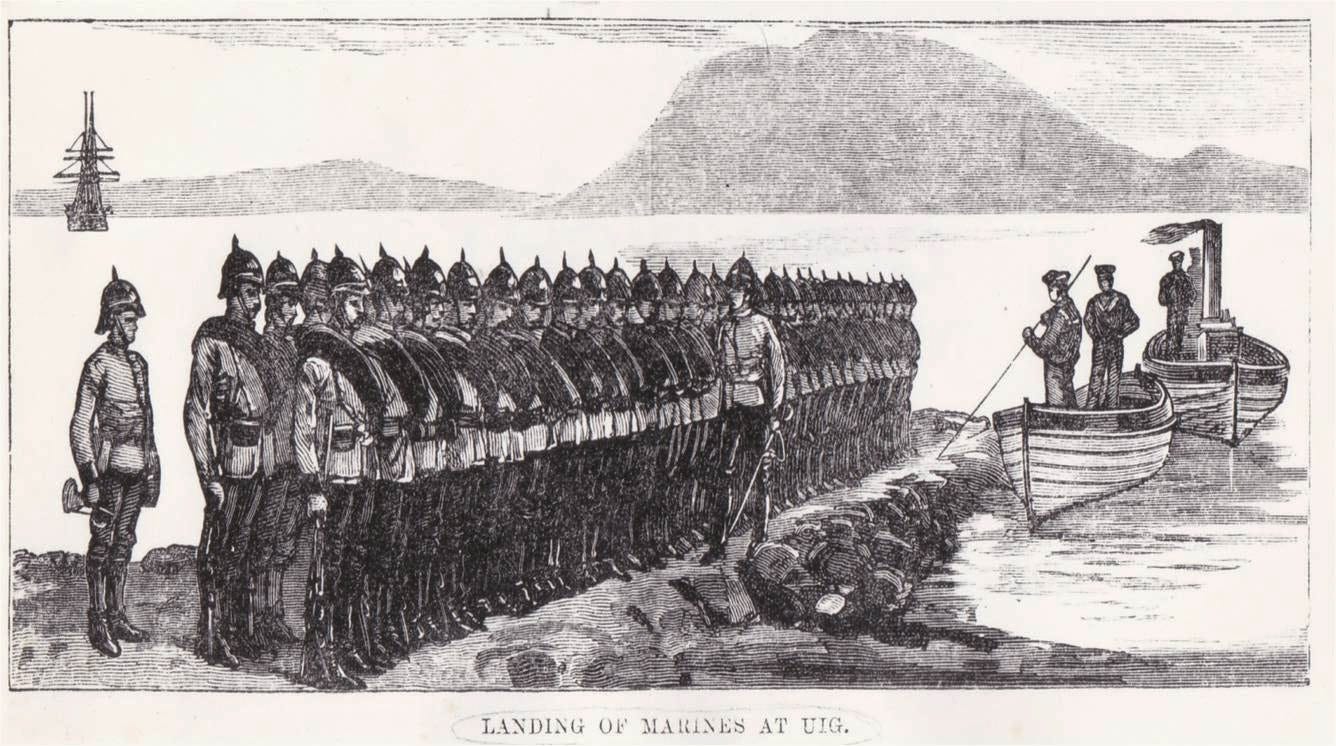
This article from August 1886 tells the story of the actual arrest, which is almost farcical for the commonplaceness of its description:
At last the cluster of cottages and huts called Ballemartin, five miles from Scarnish was reached. Scarcely had the township been entered than a halt was made, and a few policemen, advancing towards a group of men who were standing gossiping at a gable, laid hands on one of them and brought him away. Not the slightest resistance was made, his companion merely looking on. Colin Henderson, the man who was apprehended, expressed a desire which he pressed with some persistency, to be allowed to go home to change his clothes; but he was informed the clothes would be sent in the evening by his friends to the place of his confinement.
Before a judge in Edinburgh in October, Colin and his fellow “rebels” were sentenced to six-month’s imprisonment in Calton Jail. As one inmate described the place 35 years later: “It was by far the worst prison in Scotland; cold, silent and repellent. Its discipline was extremely harsh, and the diet atrocious.”
Colin died on Tiree in 1908.
I do not know how his uncle’s or his great-grandfather’s stories shaped my own great-grandfather, Alexander. Were they stories that were told often? He may have met Colin as a young person. Or maybe he didn’t? After all, his mother was a Campbell.
Colin’s brother, Donald, my great-great-grandfather, lived for a time with my grandfather Angus in Toronto. I wonder if he would have told him the story of the cruel Bàillidh Mòr, John Campbell, or of his brother Colin’s brave act of resistance, or of the “fertile green island” of Tiree?8
- Ultimately, after Mary’s death and the death of her younger sister Anne, the crown went to the German descendants of their aunt Sophia, the Electress of Hanover, the granddaughter of James I. She died just two months before Anne did, so never ascended. Instead, her German-speaking son, George I, ultimate namesake of the current heir to the throne, Prince George, did. ↩︎
- Unfortunately, this practice continues to crop up today. ↩︎
- I am not sure whether it played a role, but it may be helpful to note that the Hendersons had long been tied to the MacDonalds and the MacLeans, both families who had been in conflict with the Campbells for generations. ↩︎
- It’s all connected, right? The Scottish immigrants across Canada in the 1800s were often fleeing the oppressive changes to their way of life that was occurring in their homelands at the hands of greedy, oppressive men. ↩︎
- I highly recommend spending time on the Tobar an Dualchais/Kist o Riches website. There are hours and hours of recordings here, including a number about the Henderson family. ↩︎
- The kind of person who was so awful that they got a song written about them after they died that concludes with the line: “they all got down on their knees and praised God that you had died.” ↩︎
- Donald Meek’s account of the events surrounding the Crofters’ War is meticulously researched and quite convincing on the whole. That said, it does seem as though the president of the Land League should perhaps have communicated his intentions more widely than he did. ↩︎
- One of the other people arrested was Tiree’s bard, John MacLean, who actually wrote a song about the events called, Oran Nam Priosanach (The Prisoner’s Song). I have not been able to find a translation of it to date. ↩︎